An air fryer can cook beef quickly, but a timer alone cannot tell you when it is done. Steak thickness, burger starting temperature, basket airflow, and the way a particular air fryer holds heat can all change the result.
Use the times below to know when to start checking. Use an instant-read thermometer to decide when beef is done.
The short version: Under USDA consumer guidance, whole beef steaks and roasts should reach 145°F (63°C) and rest for at least 3 minutes. Ground beef burgers and meatballs must reach 160°F (71°C) in the center.
Beef Air Fryer Cooking Chart (Printable Reference)
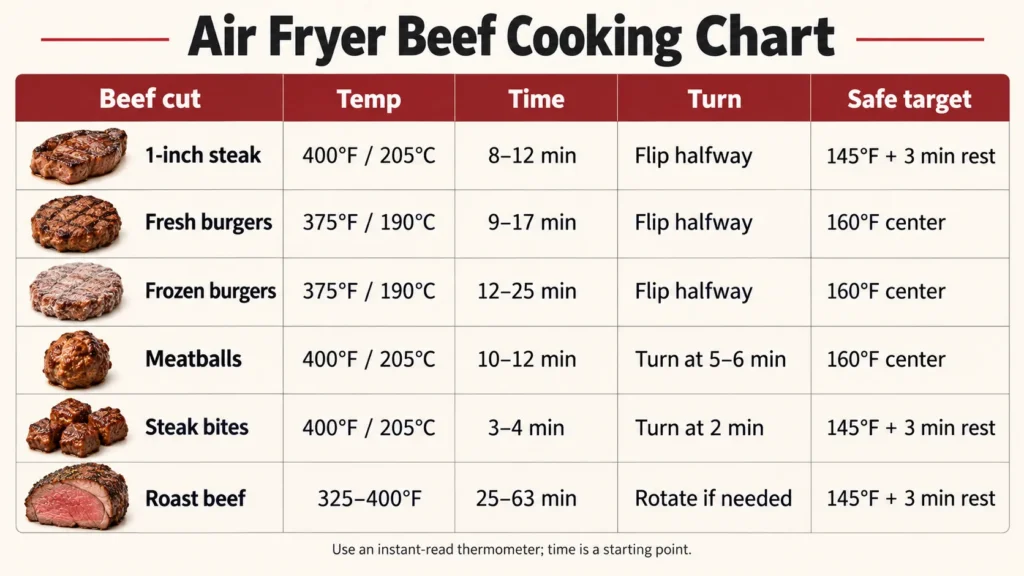
Save or print this table for quick reference. Times assume a preheated air fryer, beef arranged in one layer, and open space around the food for airflow. Check temperature before the final minute; browning and color are not food-safety tests.
| Beef cut |
Air fryer temperature |
Estimated time |
Turn or shake |
Temperature target |
| Ribeye or NY strip, 1 inch, 10–12 oz |
400°F / 205°C |
8–12 minutes |
Flip at 4–6 minutes |
Whole-cut USDA endpoint: 145°F, then 3-minute rest |
| Thick ribeye or filet, 1.5 inches, 14–16 oz |
400°F / 205°C |
12–16 minutes |
Flip halfway |
Whole-cut USDA endpoint: 145°F, then 3-minute rest |
| Sirloin, 1 inch, about 8 oz |
400°F / 205°C |
8–12 minutes |
Flip halfway if needed |
Whole-cut USDA endpoint: 145°F, then 3-minute rest |
| Fresh beef burgers, 5–6 oz |
375°F / 190°C |
Start checking at 9 minutes; allow 9–17 minutes |
Flip halfway |
160°F / 71°C in the center |
| Frozen beef burgers, 5–6 oz |
375°F / 190°C |
Start checking at 12 minutes; allow 12–25 minutes |
Flip halfway |
160°F / 71°C in the center |
| Beef meatballs, 1.5 inches |
400°F / 205°C |
10–12 minutes |
Shake or gently turn at 5–6 minutes |
160°F / 71°C in the center |
| Steak bites, 1-inch cubes |
400°F / 205°C |
3–4 minutes for a culinary medium-rare result |
Turn at 2 minutes |
Whole-cut USDA endpoint: 145°F, then 3-minute rest |
| Beef tenderloin roast, 2–3 lb |
400°F for 5 minutes, then 360°F / 182°C |
About 25–40 minutes |
Rotate once if browning is uneven |
Whole-cut USDA endpoint: 145°F, then 3-minute rest |
| Eye of round roast, 2.5–3.5 lb |
325°F / 165°C |
About 40–63 minutes |
Turn halfway if practical |
Whole-cut USDA endpoint: 145°F, then 3-minute rest |
Why does the burger range look so wide?
It is deliberately wide. In controlled testing of ten domestic air fryers, chilled beef burgers needed 13–17 minutes and frozen burgers needed 17–25 minutes to complete the study’s safety process—even when the fryers were calibrated to the same air temperature. A short programmed cycle can be a useful first check, but it is not proof that the center is safe.
Air Fryer Beef Doneness Temperatures: Safety, Pull Temp & Final Temperature
There are three temperature ideas that often get mixed together:
- Safe minimum temperature is the USDA consumer food-safety recommendation.
- Pull temperature is the temperature at which a recipe removes a whole cut from heat, expecting it to rise while resting.
- Final doneness temperature is the temperature after resting that describes a steak or roast’s culinary doneness.
For ground beef, keep it simple: cook to 160°F in the center before removing it from the air fryer. A short rest can improve juiciness, but it does not replace the 160°F endpoint.
For whole cuts, USDA consumer guidance is 145°F before removal followed by a 3-minute rest. The lower temperatures in the next chart are common culinary doneness references, not a replacement for that safety guidance.
| Culinary doneness |
Typical final internal temperature |
Typical pull temperature for a resting whole cut* |
| Rare |
120–125°F / 49–52°C |
115–120°F / 46–49°C |
| Medium-rare |
130–135°F / 54–57°C |
125–130°F / 52–54°C |
| Medium |
140–145°F / 60–63°C |
135–140°F / 57–60°C |
| Medium-well |
150–155°F / 66–68°C |
145–150°F / 63–66°C |
| Well-done |
160°F+ / 71°C+ |
155°F+ / 68°C+ |
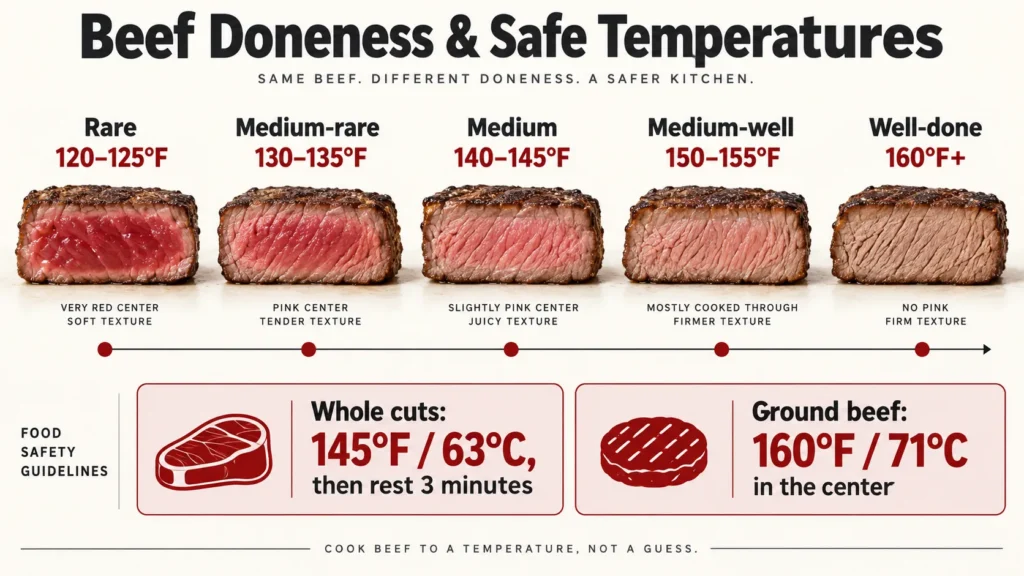 *A 5°F pull buffer is a useful starting convention, not a guarantee. A small steak may rise only a little; a large roast can rise more. Measure, rest, and learn how your own appliance behaves.
Important: A medium-rare chart describes appearance and texture. It is not a food-safety exception. If you follow USDA consumer guidance, take whole cuts to 145°F before removal and rest them for 3 minutes.
How to Use a Meat Thermometer for Air Fryer Beef
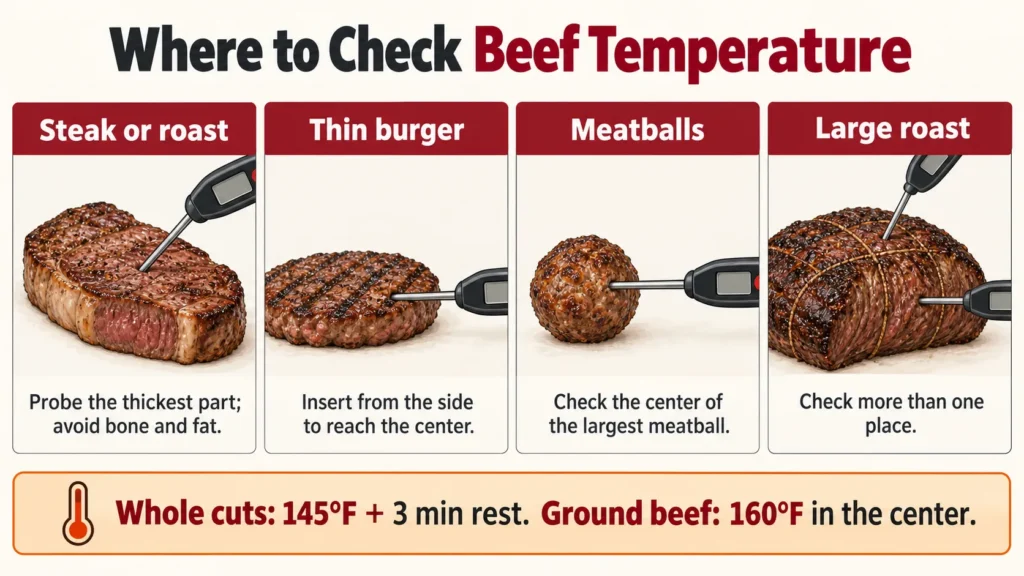
An accurate instant-read thermometer is the most useful tool for air fryer beef doneness.
- For a steak or roast, probe the thickest part and avoid bone, fat, and gristle.
- For a thin burger, insert the probe horizontally through the side until the sensing area reaches the center.
- For meatballs, check the center of the largest ball.
- For a large or irregular roast, check more than one place.
- Remove the food from the basket before probing when that makes the reading safer and easier.
USDA specifically recommends side-entry probing for thin patties and warns that color cannot reliably show whether ground beef is safe.
Air Fryer Steak Times and Temperatures (Ribeye, Strip, Filet & Sirloin)
For a 1-inch ribeye or New York strip, preheat to 400°F and begin checking at 8 minutes. Flip halfway through so both sides brown evenly. A Food Network Kitchen test for 1-inch NY strips used 4–6 minutes per side in a preheated 6-quart air fryer for a culinary medium-rare result.
For a 1.5-inch ribeye or filet, use the same 400°F setting but expect a longer 12–16 minute checking window. Thick steaks are more forgiving because they can brown outside before their center races past the target. Flip at the halfway point and check temperature early rather than adding a fixed number of minutes.
For a 1-inch sirloin, start checking at 8 minutes. Food Network Kitchen’s 1-inch sirloin test used 400°F and gave 10 minutes for culinary medium-rare, 12 minutes for medium, and 14 minutes for medium-well—but its steak weighed 1 pound, so a smaller 8-ounce sirloin may finish earlier.
Air Fryer Steak Checklist
- Pat the steak dry so the surface can brown instead of steam.
- Preheat if your appliance supports it.
- Keep steaks in one layer with space between them.
- Flip at the midpoint.
- Check the center with a thermometer before the expected finish.
- Rest before slicing.
How Long to Cook Beef Burgers in an Air Fryer (Fresh & Frozen)
Make 5–6-ounce burgers an even thickness and press a shallow dimple in the center of each patty. The dimple helps counter the doming that can happen as ground beef contracts.
Fresh Beef Burgers
For fresh patties, set the air fryer to 375°F and start checking at 9 minutes. Flip at the midpoint. An air-fryer manufacturer recipe uses 375°F for 9 minutes for roughly 5.3-ounce patties, but your patties must still reach 160°F at the center.
Frozen Beef Burgers
For frozen patties, do not thaw. Start checking at 12 minutes, flip halfway, and continue until the center is 160°F. A frozen burger can look browned outside while the center is still far below its safe temperature, particularly in a slower-heating appliance.
Do not judge a burger by color. Ground beef can stay pink after reaching 160°F, and it can also brown before it is safe. The thermometer decides.
Air Fryer Beef Meatballs Cooking Time
For 1.5-inch meatballs, preheat to 400°F and cook for about 10–12 minutes. Shake the basket or gently turn the meatballs around the halfway point. Check the largest one for 160°F in the center.
Keep the meatballs in one layer. They can touch lightly, but do not pile them up. If your recipe includes breadcrumbs, egg, cheese, or added vegetables, make every meatball the same size and check the largest one first.
Air Fryer Steak Bites Cooking Time
Cut steak bites into evenly sized 1-inch cubes and trim any large, hard-to-render pieces of exterior fat. Preheat to 400°F, place the cubes in one layer, cook for 2 minutes, then turn or shake them. Continue for 1–2 minutes for a culinary medium-rare result, checking temperature if you need a specific endpoint.
Small cubes cook quickly. A crowded basket slows browning and creates uneven pieces, so cook in batches rather than stacking.
Air Fryer Roast Beef Times: Tenderloin and Eye of Round
Beef Tenderloin Roast, 2–3 Pounds
A useful high-heat-then-lower-heat starting method is 400°F for 5 minutes to brown the exterior, then 360°F until the center reaches your chosen temperature. Depending on the roast’s thickness and shape, plan about 25–40 minutes total and start probing before the 25-minute mark.
Rest tenderloin for 10–15 minutes before slicing. For clean slices, cut across the grain. If following USDA consumer guidance, confirm 145°F before the roast leaves the air fryer, then rest it for at least 3 minutes.
Eye of Round Roast, 2.5–3.5 Pounds
Eye of round is lean, so its center temperature matters more than a minute-per-pound promise. At 325°F, use 16–18 minutes per pound only as a planning guide—about 40–63 minutes for a 2.5–3.5-pound roast. Start checking well before the high end of the range.
Rest for 10–15 minutes before carving and slice thinly across the grain. Confirm that the roast physically fits with open airflow around it; a roast pressed against the basket walls will not cook like a smaller, centered roast.
What Affects Air Fryer Beef Cooking Time?
Thickness matters more than weight
The distance from the hot air to the center is what matters most. A long, thin roast may weigh more than a compact roast but still cook faster because heat travels a shorter distance to the center. Professional culinary guidance describes thickness—not weight—as the key driver of roasting time.
Bone-in and boneless cuts are not interchangeable
Bone, shape, fat cover, and exposed surface all change heat movement. Do not replace a boneless steak with a bone-in steak and assume the same timer will work. Check the thickest edible center, away from bone.
Air fryer design changes real cooking speed
Capacity is not just a number on the box. Basket shape, usable single-layer surface area, fan circulation, heating recovery, and thermostat accuracy all affect time. The USDA notes that air fryers vary in size and power, while safe final temperatures do not.
Starting temperature changes the clock
Fridge-cold beef, briefly rested beef, and frozen beef need different cook times. Keep raw meat refrigerated until prep time, and do not leave it out for more than 2 hours—or more than 1 hour when the ambient temperature is above 90°F.
How to Prevent Smoke When Air Frying Fatty Beef
Ribeye and high-fat burgers can render enough fat to smoke in the drawer below the basket. If white smoke appears, stop cooking and follow your appliance manufacturer’s instructions. Once it is safe and cool enough to handle, remove accumulated grease as directed.
Do not deliberately create smoke for a darker crust. Keep the drawer and heating area clean, trim large exterior fat deposits from steak bites if needed, and never add water to a grease fire.
Air Fryer Beef Cooking Times FAQ
What temperature should I air fry steak at?
For ribeye, strip, filet, and sirloin, 400°F / 205°C is a practical starting setting. The correct finish is decided by the center temperature, not by the setting alone.
How long do I air fry a 1-inch steak?
Start checking between 8 and 12 minutes at 400°F, flipping halfway through. A 1-inch steak may cook faster or slower based on its thickness, starting temperature, fat content, and fryer.
What temperature should beef burgers reach in an air fryer?
Ground beef burgers must reach 160°F / 71°C at the center. Insert the thermometer from the side of the patty so it reaches the middle.
Do I need to flip beef in an air fryer?
Flip steaks and burgers halfway for more even browning. Shake or gently turn meatballs and steak bites at the midpoint. Air circulation helps, but the basket contact surface can still brown differently.
Can I stack steak bites or meatballs?
No. Cook in a single layer whenever possible. Stacking blocks airflow and makes both browning and center temperature less predictable.
Should I rest steak after air frying?
Yes. Resting helps the juices settle. For whole cuts, USDA also specifies at least a 3-minute rest after reaching its 145°F safe minimum.
What is the best way to reheat steak or burgers in an air fryer?
Reheat gently and check the center often so leftovers do not overcook. Refrigerate cooked leftovers within 2 hours.
Source and Editorial Notes
- Food-safety statements in this article follow USDA guidance for whole cuts and ground beef.
- The time ranges are deliberately broader than a single recipe because independent testing has shown significant performance variation between air fryers.
- Before publishing an exact equipment-specific time card, test it with the intended basket style, stated meat thickness and weight, recorded starting temperature, and an instant-read thermometer.
About the author

Written by Mia Carter
Airfryeratlas editorial team
Mia Carter is a home-cooking editor who tests air fryer recipes, cooking times and practical kitchen tips to help everyday cooks get reliably crisp, delicious results.